 Pumpfun
Pumpfun liquidity providers receive PumpSwap LP tokens
Pumpfun liquidity providers receive PumpSwap LP tokens when they add paired assets to a pool. Those tokens represent a share of its underlying liquidity, which changes as trading alters the reserves. Removing liquidity uses PumpSwap's withdrawal instruction, which burns LP tokens and returns both assets. Burning LP tokens directly does not return the underlying assets.
On this page
A pool position suits someone willing to supply both assets for trading and accept changes in their relative balances. Keeping the assets separately preserves their individual quantities. The difference affects both potential fee income and the assets available on exit.
Key takeaway: PumpSwap withdrawals redeem LP tokens for underlying assets, while a direct LP token burn surrenders the share without returning those assets.
Paired deposits turn assets into pool shares
A PumpSwap deposit adds the pool's base and quote assets together, then mints LP tokens representing the liquidity the provider contributes. Boosted pools use an additional virtual quote amount for pricing, and PumpSwap does not support liquidity deposits or withdrawals on them. The base token is the asset the pool prices in the quote token. These labels identify the sides of the pair; they do not describe a token's quality or guarantee its value.
An existing pool determines deposit proportions through its liquidity accounting and recorded LP supply. Holding enough of one asset alone does not satisfy the other side. Deposit calculations connect the desired LP output to the required input amounts, so a provider cannot choose unrelated amounts for an existing position.
Deposits specify an exact LP output and separate maximum inputs for both assets. Each maximum caps spending if required amounts change before execution; the cap does not state the eventual amount spent.
Supplying liquidity exchanges direct holdings for exposure to the pool's inventory. Traders subsequently buy one asset and sell the other against that inventory. The LP token balance records the share position, while the underlying quantities change with pool activity. An unchanged LP balance therefore does not imply unchanged withdrawal amounts.
The pool account connects the pair to its LP mint
On Solana, each PumpSwap pool records its base mint, quote mint, LP mint, and reserve token accounts, tying a liquidity position to specific assets. A mint is the on-chain account identifying a token and its supply. The LP mint identifies the pool share token; it differs from the mints of the assets traders exchange.
Pool identity remains relevant even when two pools contain the same asset pair. The pool creation mechanism permits separate pools for that pair, each with its own accounting. A token symbol alone cannot identify the correct liquidity position. The pool account's LP mint provides the connection between the share balance and its underlying assets.
Migration burns and removable liquidity
Pumpfun's migrated launch liquidity has a different withdrawal status from liquidity a provider adds later to the resulting PumpSwap pool. The migration process burns the LP tokens it receives for the initial PumpSwap liquidity. Those burned tokens no longer give anyone a balance they can submit for redemption. Later deposits mint new LP tokens representing the additional liquidity.
PumpSwap keeps its own recorded LP supply, which does not fall when someone burns LP tokens directly. Its accounting distinguishes that burn from a withdrawal, preventing surviving holders from treating surrendered shares as newly available ownership. This distinction also explains why the LP mint's remaining token supply alone can misstate a holder's share.
Which liquidity operation fits the position you want?
Adding liquidity to an existing pool fits a redeemable share position; creating a pool establishes a separate trading venue with its own initial balances. The latter requires choosing both assets and their initial deposit ratio. Keeping assets outside a pool avoids a pool share position altogether, while a swap changes the asset a trader holds.
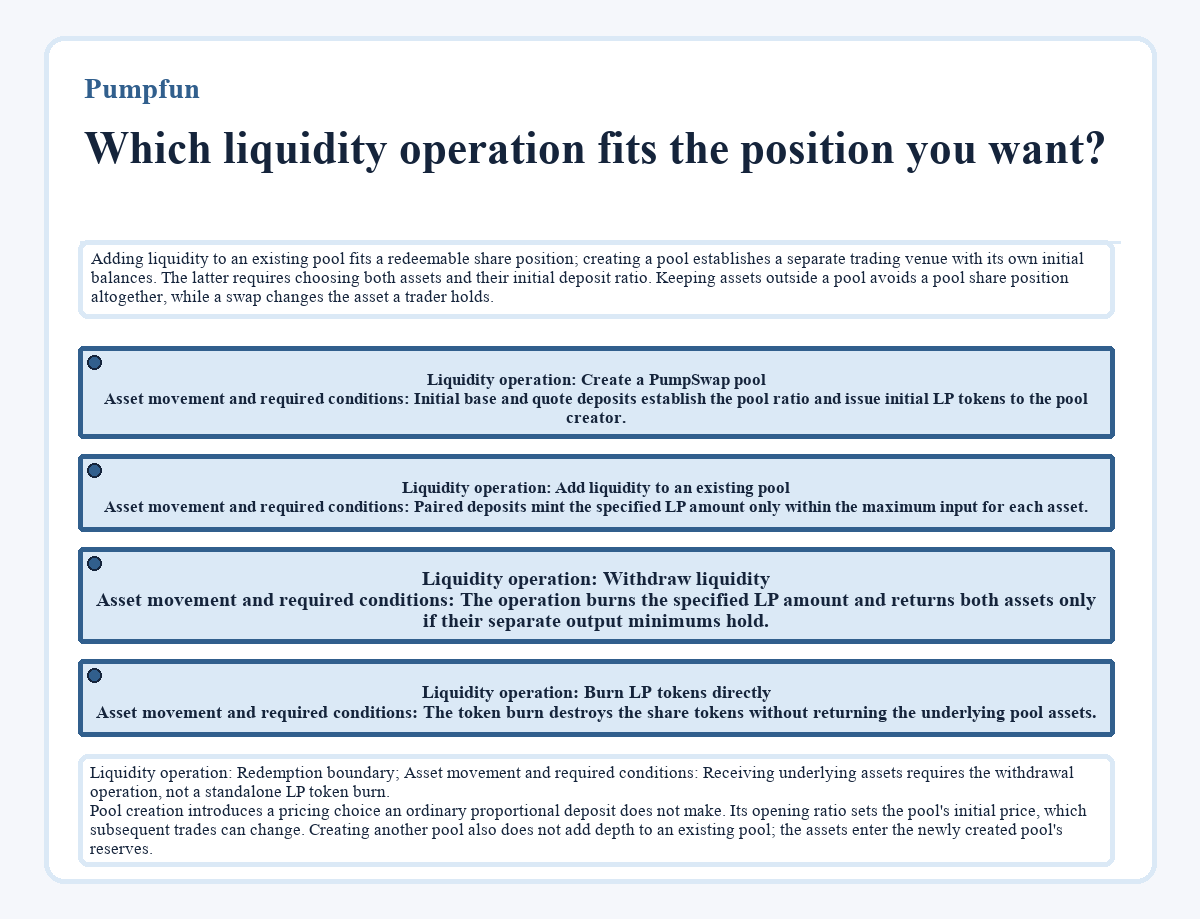
| Liquidity operation | Asset movement and required conditions |
|---|---|
| Create a PumpSwap pool | Initial base and quote deposits establish the pool ratio and issue initial LP tokens to the pool creator. |
| Add liquidity to an existing pool | Paired deposits mint the specified LP amount only within the maximum input for each asset. |
| Withdraw liquidity | The operation burns the specified LP amount and returns both assets only if their separate output minimums hold. |
| Burn LP tokens directly | The token burn destroys the share tokens without returning the underlying pool assets. |
| Redemption boundary | Receiving underlying assets requires the withdrawal operation, not a standalone LP token burn. |
Pool creation introduces a pricing choice an ordinary proportional deposit does not make. Its opening ratio sets the pool's initial price, which subsequent trades can change. Creating another pool also does not add depth to an existing pool; the assets enter the newly created pool's reserves.
How do output minimums constrain a withdrawal?
A PumpSwap withdrawal must meet the separate minimum outputs the provider sets for both underlying assets while burning the specified LP token amount. These minimums protect token quantities. They do not guarantee a particular monetary value after the assets reach the recipient's accounts.
Slippage is the difference between an estimated outcome and the actual outcome at execution. For liquidity removal, the relevant outputs are the base and quote amounts associated with the LP shares. Pool trading can change those amounts between preparing an estimate and executing the withdrawal. A quote describes an estimated balance split at a particular state.
The LP input determines how much of the share position the operation redeems. The pool's applicable reserve and supply accounting determines the underlying output amounts. Neither the original deposit quantities nor a previous withdrawal quote fixes what the same LP balance will redeem later.
If either output would fall below its minimum, the withdrawal cannot succeed under those limits. Lowering an output minimum changes the outcome the provider accepts; it does not restore the earlier reserves. The burn belongs inside the withdrawal operation, so redeeming shares does not require a preliminary direct burn.
Swap fees and the balances available to LPs
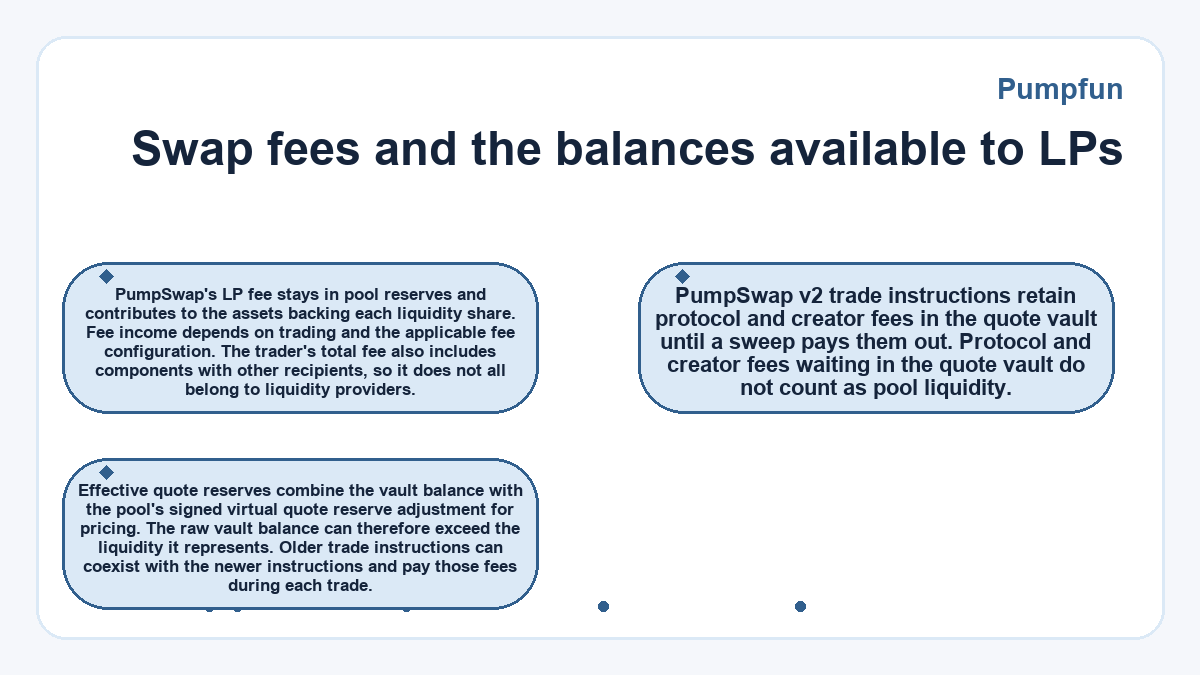
PumpSwap's LP fee stays in pool reserves and contributes to the assets backing each liquidity share. Fee income depends on trading and the applicable fee configuration. The trader's total fee also includes components with other recipients, so it does not all belong to liquidity providers.
PumpSwap v2 trade instructions retain protocol and creator fees in the quote vault until a sweep pays them out. Protocol and creator fees waiting in the quote vault do not count as pool liquidity. Effective quote reserves combine the vault balance with the pool's signed virtual quote reserve adjustment for pricing. The raw vault balance can therefore exceed the liquidity it represents. Older trade instructions can coexist with the newer instructions and pay those fees during each trade.
Inventory risk despite burned migration shares
A PumpSwap liquidity position can lose value even when nobody can redeem the LP tokens burned during migration. Selling pressure changes the pool's asset mix and the value of its reserves. Impermanent loss describes a pool position underperforming the same assets held separately because their relative prices change, before accounting for fee income. Trading fees may offset that difference, but they do not guarantee full compensation. Burning the migration shares prevents redemption through those shares; it does not stop holders from selling the launched token.
Estimates, submission, and completed liquidity changes
A liquidity quote estimates an outcome, while a successful on-chain transaction establishes whether the deposit or withdrawal actually changed the position. A transaction signature identifies a transaction without proving its submission or successful execution. Solana's submission service can return that identifier before the network confirms the transaction.
Deposit records distinguish the maximum permitted inputs from the base and quote amounts actually contributed. Withdrawal records similarly distinguish minimum accepted outputs from the amounts actually returned. The successful transaction's liquidity event and token balance changes provide those amounts. A confirmed transaction can still contain an execution error, so its status and balance changes need to agree.
A refreshed quote does not resolve a pending liquidity transaction. Uncertainty about its status leaves the intended position change unconfirmed, even when an interface already displays a new estimate.
Account upgrades and disabled operations
An older PumpSwap pool account may need expansion before deposit or withdrawal instructions can use fields introduced by an upgrade. A quiet pool may retain its shorter layout until an operation updates it. The permissionless
extend_account
instruction expands the account for the additional data; an integration must address that requirement before the affected liquidity operation.
Global configuration also lets the administrator disable liquidity operations, which limits availability independently of a holder's LP balance. A slippage failure, an undersized account, and a disabled operation require different responses. Solana reverses instruction changes when an executed transaction fails, although it still charges transaction fees. Account expansion addresses the layout requirement; it does not override a disabled PumpSwap withdrawal.
Pumpfun questions, answered
Can I withdraw only part of my PumpSwap LP balance?
PumpSwap supports partial liquidity withdrawals from non-boosted pools when withdrawals are enabled. You specify the LP token amount to redeem. The remaining LP tokens continue to represent the position left in the pool. Withdrawal output minimums apply to the portion being redeemed, so partial removal does not require surrendering the entire share balance.
Where can I look if my wallet does not display my PumpSwap liquidity position?
The pool's LP mint identifies the token balance representing your liquidity position. A wallet may omit its label or valuation, so a missing display alone does not establish a missing deposit. Token account balances and the successful deposit transaction distinguish an undisplayed LP token from a transaction that never created shares.
Does adding PumpSwap liquidity require the coin creator's approval?
PumpSwap's deposit instruction requires the liquidity provider's signature, not a separate signature from the coin creator. The instruction still needs a non-boosted pool, the correct accounts, adequate asset balances, and input limits permitting the deposit. Global settings can disable deposits regardless of who created the coin.
Which balance pays transaction fees for a PumpSwap liquidity operation?
Solana charges transaction fees to the transaction's designated fee payer in SOL. Tokens already deposited in the pool cannot pay that fee. Adequate deposit asset balances do not ensure the fee payer can fund execution; the liquidity operation also requires available SOL for its network fee.
Can someone withdraw my PumpSwap liquidity using only my public wallet address?
A public wallet address alone cannot authorize a PumpSwap withdrawal. The program requires the user's transaction signature for the liquidity operation. Sharing an address for viewing balances does not provide that signature, while exposing signing credentials can give another person control over transactions affecting the position.
When does a new liquidity deposit begin participating in PumpSwap swap fees?
A deposit begins participating once successful execution adds its assets and mints its LP tokens. A prepared quote or pending submission creates no additional share position. Earlier fees already reflected in pool reserves also affect the deposit calculation, so newly issued LP tokens do not provide a free allocation of previous fee income.