 Pumpfun
Pumpfun fees apply to trading and graduation while Solana coin creation has no platform charge
Pumpfun fees include trading charges and graduation costs, while Solana network fees add to the total transaction cost. Solana coin creation has no platform creation charge, although an on-chain launch or initial purchase still needs funding. A bonding-curve buy, a graduated coin's PumpSwap trade, and a creator-fee claim involve different cost inputs. The applicable contract configuration controls trading charges; network fees, account creation, and any interface extras can change the amount the wallet must supply.
The short version: A quote-asset balance can cover the purchase while SOL balances still fall short of network fees or required account funding.
Creation and the first funded purchase
A launch with an initial purchase needs a different funding estimate from a coin entry without a buy. The transaction may need funds for token acquisition, trading charges, and new account storage. Buying an existing coin avoids creating another mint, although its trade can still require new accounts.
Creation without an initial purchase
The free creation flow can defer on-chain creation to the first buyer. That buyer's transaction then performs the on-chain work. Directly creating a mint through the program needs funding for the relevant accounts. Deferring those expenses changes when someone pays them; it does not remove the costs of the eventual funded trade.
Creation with an initial purchase
An initial buy adds the coin purchase and its trading charges to the launch's account funding requirement. Creation and buying can share one transaction when the selected builder supports both. Counting these conceptual actions as separate transactions would overstate network fees in that case.
Bonding-curve charges and PumpSwap pool fees
The coin's trading venue and quote asset determine which fee configuration applies before a percentage becomes a meaningful cost estimate. The quote asset is the asset used to price the coin.
Bonding-curve trades
The Pump program reads applicable fee settings when pricing a curve purchase or sale. SOL- and USDC-paired coins follow the standard schedule. A custom quote pair can carry a coin-specific creator rate. The fee configuration supplies standard rates; a custom creator rate is stored on the coin's curve. A percentage copied from an older trade may not describe another transaction.
Canonical and non-canonical pools
The pool a completed Pumpfun curve's migration creates is its canonical PumpSwap pool. PumpSwap canonical pools use market-capitalization tiers for their standard trading fees. Other PumpSwap pools use the non-canonical schedule, with any custom creator-rate override read from the pool. Pool identity and the applicable market-capitalization tier therefore matter when estimating a graduated coin's trading charge.
Multi-hop swaps
PumpSwap's multi-hop instruction charges protocol fees once, on the first leg of a buy or the last leg of a sell. That leg trades the user's funding or proceeds asset. The leg trading the target coin charges the creator fee. It also charges a liquidity-provider (LP) fee when that leg uses a pool. Intermediate legs charge no additional trading fee under this instruction. Separately submitted swaps each apply their own fee rules. The components can use different quote assets, so their raw amounts need a common valuation basis before addition.
How are the trading fee components calculated?
Trading fees combine the applicable protocol, creator, and pool liquidity charges under the selected instruction's own calculation rules. Rates expressed in basis points convert to a fraction by division by 10,000. For a component using quote amount Q and rate b, its nominal charge is Q × b / 10,000. Q means the amount the program uses for that component, which need not equal the entire spending budget. Integer rounding and exact-input budgeting affect the final deduction.
The protocol component goes to designated protocol recipients. PumpSwap liquidity-provider fees remain in the pool reserves and benefit its liquidity position holders. They do not measure the trader's gain or loss on the token.
Graduation costs and liquidity funding
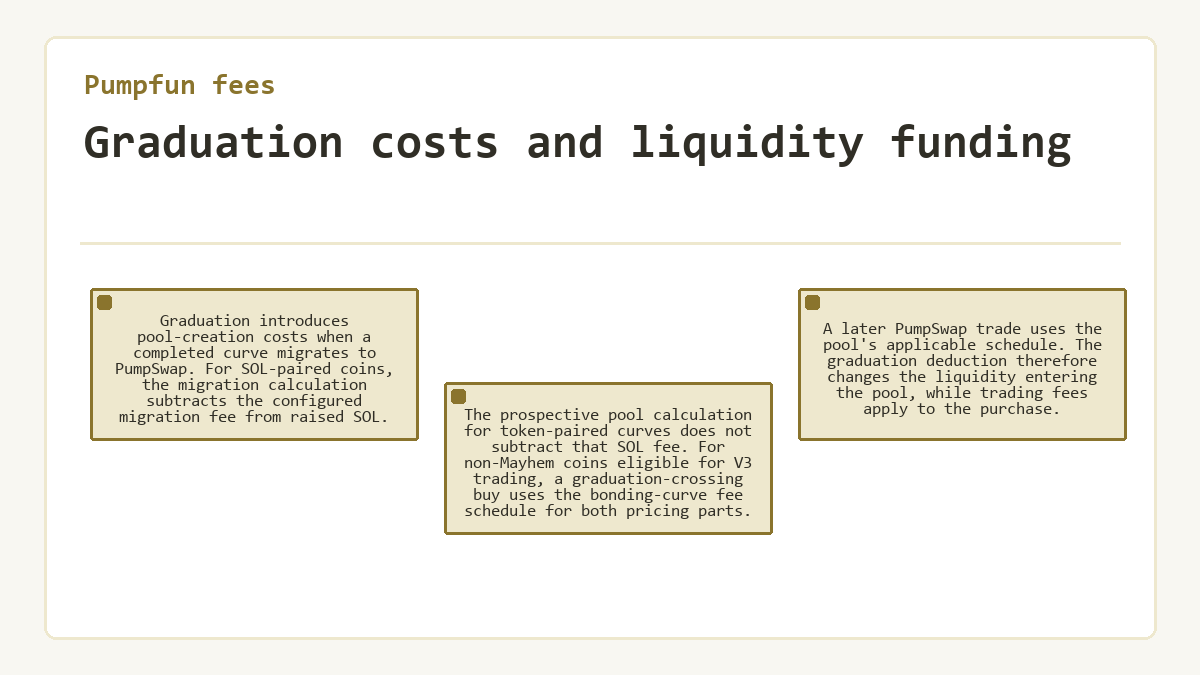
Graduation introduces pool-creation costs when a completed curve migrates to PumpSwap. For SOL-paired coins, the migration calculation subtracts the configured migration fee from raised SOL. The prospective pool calculation for token-paired curves does not subtract that SOL fee. For non-Mayhem coins eligible for V3 trading, a graduation-crossing buy uses the bonding-curve fee schedule for both pricing parts. A later PumpSwap trade uses the pool's applicable schedule. The graduation deduction therefore changes the liquidity entering the pool, while trading fees apply to the purchase.
Network charges and account funding
Solana network fees and storage funding can require native SOL even when the coin trades against another quote asset. For transactions through Pumpfun on supported Ethereum Virtual Machine (EVM) networks, the published terms specify a configurable percentage fee intended to pay gas and transaction costs. Pumpfun does not separately track those actual costs.
Base and priority charges
Base fees depend on signatures; optional priority fees pay for transaction scheduling priority. Solana deducts the network fee from the transaction's fee payer before execution begins. Paying a larger priority fee leaves the swap's pricing formula unchanged. The transaction format and compute budget determine the network amount, which remains separate from Pumpfun's trading charge.
An on-chain execution failure still incurs the network fee. Simulation runs without broadcasting the trade, so a simulation error does not itself incur an on-chain transaction fee.
Funding new accounts
Trading can also require SOL to initialize token accounts, create tracking accounts, or top up older program accounts. These storage balances differ from network fees and swap charges. Existing accounts can remove a setup requirement from a later transaction. Required funding depends on the selected instruction and the accounts it actually needs. Some trade instructions require user token accounts to exist already; a builder may add their creation instructions. The launch estimate must also account for creating the mint and its curve.
The relevant program controls account closure. A storage deposit becomes spendable again only when permitted closure returns its balance.
Why can a wallet debit exceed the quoted swap amount?
A wallet debit can include network charges and account funding which a quote for the token trade alone does not include. On a V2 bonding-curve buy, the maximum quote cost includes protocol and creator fees. On its matching sell, the minimum quote output is after those charges. Read a displayed amount as a spending budget, expected output, or limit according to its actual function. Adding trading fees again to a quote which already includes them would double-count the charge.
Price impact changes the trade's average execution price. Slippage describes quote-to-fill variation. Neither automatically equals a separate service charge.
A higher slippage setting accepts a wider execution range; it does not prescribe an additional fixed fee. A difference between spending and displayed holdings can reflect valuation, market movement, and trading costs together. The completed transaction's transfers and charged amounts identify the actual fee. A maximum spend limits the trade's quote cost without covering every other debit the transaction can require.
A blocked purchase and a smaller retry
In this hypothetical example, a simulation flags insufficient funds for a proposed first curve purchase. Every amount uses units of the native network coin, which also prices this curve. The wallet holds 0.046 units. Its proposed maximum purchase debit, including trading fees, is 0.038 units.
The transaction also needs 0.0096 units for network charges and required account funding. Rechecking the proposed transaction identifies those costs before approval. The total requirement is 0.038 + 0.0096 = 0.0476 units, exceeding the wallet balance by 0.0016 units. The purchase budget fits by itself, while the complete transaction does not.
Reducing the requested token amount and refreshing its quote lowers the maximum purchase debit to 0.036 units in this case. Holding the other funding estimate unchanged gives a total requirement of 0.0456 units. The revised estimate fits the wallet, leaving 0.0004 units. A new simulation checks the revised transaction before submission.
A purchase paid in another quote asset needs a separate native-fee balance check. Reducing that asset's order does not necessarily repair a native-coin shortage; fund the wallet responsible for the missing network or account payment before retrying. Creating a new coin with an initial buy also needs its own mint and curve account-cost estimate.
Creator earnings after trading charges
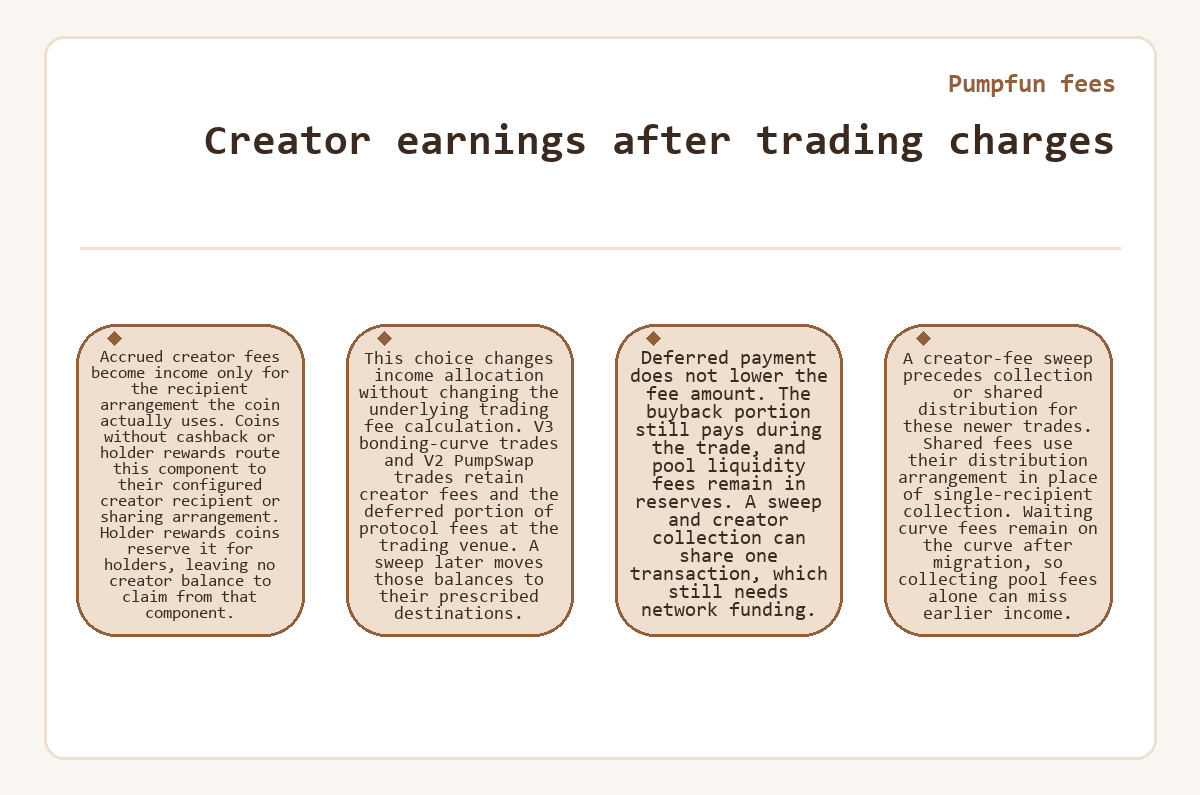
Accrued creator fees become income only for the recipient arrangement the coin actually uses. Coins without cashback or holder rewards route this component to their configured creator recipient or sharing arrangement. Holder rewards coins reserve it for holders, leaving no creator balance to claim from that component. This choice changes income allocation without changing the underlying trading fee calculation.
V3 bonding-curve trades and V2 PumpSwap trades retain creator fees and the deferred portion of protocol fees at the trading venue. A sweep later moves those balances to their prescribed destinations. Deferred payment does not lower the fee amount. The buyback portion still pays during the trade, and pool liquidity fees remain in reserves. A sweep and creator collection can share one transaction, which still needs network funding.
A creator-fee sweep precedes collection or shared distribution for these newer trades. Shared fees use their distribution arrangement in place of single-recipient collection. Waiting curve fees remain on the curve after migration, so collecting pool fees alone can miss earlier income.
Pumpfun fees: common questions
Are Pumpfun trading fees lower when I sell at a loss?
A loss on the token does not itself reduce the trading fee. The applicable charge follows the transaction's fee configuration and trade amount. Your original entry price does not enter that fee calculation. Selling below your purchase price can therefore produce both a trading loss and another transaction charge.
Can buying my own coin recover the entire trading fee?
The creator component can accrue to your configured recipient arrangement. It represents only part of the total charge. Protocol fees, any applicable pool liquidity fee, and network spending have other destinations. Holder rewards coins direct the creator component to holders. Fee-sharing arrangements can also divide it among recipients, so the token's creator does not automatically receive the entire fee.
Does using a V3 curve instruction reduce the trading percentage?
Supported V3 bonding-curve trades use the same prices and trading fee amounts as the corresponding V2 trades. Their smaller account set and deferred fee payment change transaction construction and payout timing. They do not provide an automatic percentage discount. Network and account-funding differences require a comparison of the actual transactions.
Will buying and selling at an unchanged price return my original spending?
An unchanged token price does not cancel the charges on the buy and sell. A break-even exit requires net sale proceeds, after the sale's trading and network charges, to match the purchase's total cost. That purchase cost includes its own fees. Price impact and other market trades can change the actual proceeds, even when a displayed token price looks unchanged.
Do existing cashback coins refund every fee on a buy?
Existing cashback coins accrue the creator-fee component as claimable cashback, while protocol, network, and any applicable pool liquidity charges remain. Legacy PumpSwap buys must include the required cashback account, or the creator receives that component instead. New cashback coins cannot be created, although existing coins remain tradable and accrued cashback remains claimable. V3 curve trades and V2 PumpSwap trades reject cashback coins; their supported older counterparts remain available.
Is there a PumpSwap trading fee for adding or removing liquidity?
PumpSwap's deposit and withdrawal instructions do not charge its buy or sell trading fee. Their transactions still need network funding and can require account storage funding. Any separate swap used to obtain the deposit assets follows its own trading fee rules. The assets contributed to the pool represent liquidity capital, which is distinct from transaction charges.
What fee differences can appear between web and mobile trades?
Some mobile transactions may include an extra charge under Pumpfun's mobile fee arrangements. This can make a mobile trade cost more than an otherwise comparable web trade. Third-party trading interfaces may add their own fees as well. The final contract charge and any interface charge determine the platform and interface fees you pay; a displayed estimate can differ from the contract's deduction.